

Desert Song


A story inspired by two songs—Desert Song and Oman—by Dead Can Dance
I had never before been to the desert. Born and reared in the city, I found the barren, dry wastes whose dimensions across all maps bordered on the obscene to be a phenomenon that courted madness. All deserts, I decided early on as a child, were the workings of demented demi-gods out to insult their parents.
These flirtations with nothingness, called deserts, were kept on this earth as sprawling peccadilloes. A wayward twig every ten miles or so, interrupted by tall dunes whose shape gave a mocking semblance of life, did little in the way of ecology.
But it was to one such desert I was one day drawn. Like all mysteries in life, or other things that spawn poems that can leave cherubs asphyxiating, it started with the infatuation with a woman.
I need not tell you into which desert I had been cast, as all deserts are the same. Their nexus points are rents in the terrestrial fabric, and their borders, which lead back to civilization, are merely abstractions that take on the characteristics of geography tailored to the person leaving the desert. In other words, all deserts are the same Desert, and the outlying terrain that confines this Desert is susceptible to transformation as dictated by the person's past, nationality, and—to a degree more unsettling than anything—one's expectations.
All modern cartography has it wrong. All deserts are liminal spaces. Any settlements, villages, and mapped constructs exist only as egregores and don’t hold true or objective provenance in the real world.
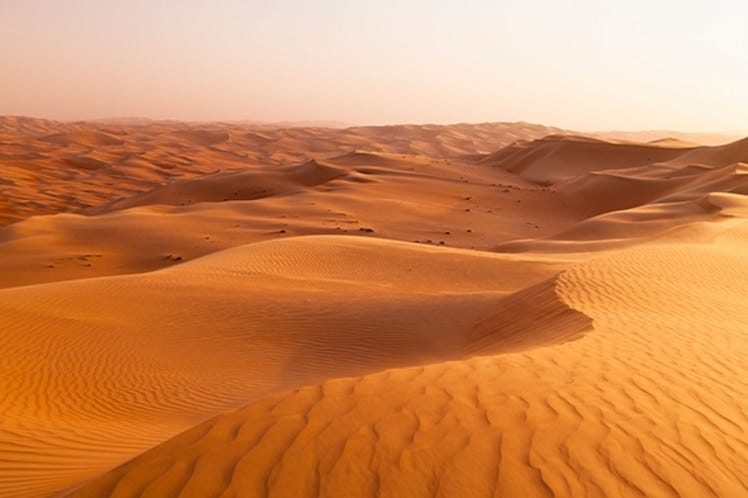
To say I had been cast into this Desert is wrong, because no person or thing had coerced me into this Desert. It was upon my own volition, rather, that I entered into the unforgiving expanse under the guise of my job as an ethno-musicologist, though it is perhaps closer to the truth that what made me enter, what had, in fact, cast me, was love.
Love. People like to define this word as if nailing it to a wall of etymology, to later point at a dead specimen of it and say, “See, this is love. Not that infatuation or fixation or validation you miscall love.” But as you may know, there are many forms of love—as many forms as there are people. So it is moot to try to freeze it in amber out of arrogance. Love is love. One knows it when one feels it.
I had gotten word in more than one city that bordered the Desert that the most beautiful song ever sung had been sung in the Desert. No one had a clue about how the song sounded, where precisely in the Desert it had been sung, why it had been sung, nor the name of the girl who had sung it. But it had been sung, so I went in search of it.
A city boy like me doesn't just traipse across deserts. Provisions and logistics must be seen to. As I had zero experience handling that ubiquitous mode of desert transport, the camel, I had to hire a camel driver. I never learned the name of this camel driver who gained my employ, since every time he threw his head back to answer me when I asked him of it, the wind tore the sound from his face and dashed it afar. He would later on die, and when I buried him I couldn't even properly honor him with a customized headstone.
I brought up the wind seconds ago. Desert winds are nothing like your traditional winds. They possess consciousness at a level below a human yet above some of our more primitive biological species. They're like elementals, being akin to the sylphs that typify the frolicksomeness of those fairies of air, though they tend more towards malice than playfulness. The harm they intend has no clear aim, so it's safe to assume it is done out of a natural proclivity that makes it a feature and not a bug.
Were it not for these winds that take advantage of the anarchy of deserts to assert themselves without retribution, my trail to find the desert song sung once by the fairest voice the world has ever known would have gone cold from the start.
I don't claim to have any fluency in the language through which the winds express themselves. Though my lexicon of windspeak is less than nil, the years of musical training that have sharpened my ear have allowed me to comprehend the nuanced timbre of their chafing against my ears, which tend toward bleeding when the winds become more voluble when wishing to drive home their arguments or refute claims not in standing with their own stubborn convictions.
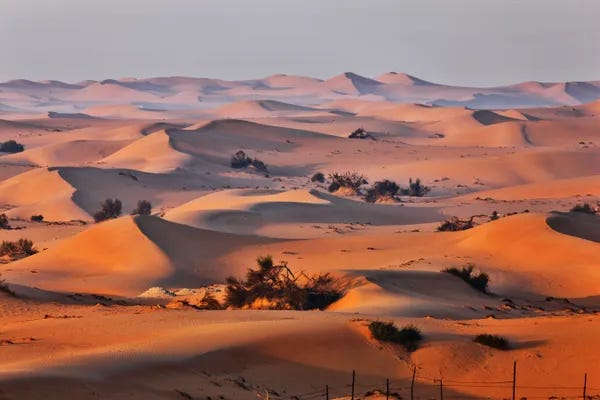
Of all the vagueness regarding the desert song, one thing was clear. It had been archived by the winds in windspeak.
This, at first, was for me disheartening. I had long imagined our mysterious chantuese emoting a plaintive longing for the listener's attentions so that, however remotely, he could feel himself to be the object of such beautifully expressed affections. Such a delight would be enough that the listener could die happy, knowing the siren of all sirens had chosen him as target for such unbelievable beauty.
But this sort of disappointment is short-changing the craftiness of the winds. Winds speak not in duration but in depth. A song too is often categorized by its duration and not its depth. The latter is everything. Whole symphonies can be compressed into milliseconds if they were to be transposed into the music of the winds.
My disappointment therefore wore off, entertaining the possibility and growing likelihood that her song held a depth and counterpoint that rivaled if not bested masterpieces known for their intricacies and encapsulations of life and all its vagaries. An initial disenchantment therefore became, as I before stated, an obsession.
Once I knew the nature of the song, I could approach its mystery from the angle of familiarity. It seems that every wind in the Desert knows every other wind, and that by the very nature of their way of communication, there are no secrets. Of course they hold treasures of secrets from the humans foolish or brave enough to trek across the Desert waste. My befriending of the winds yielded up little concerning the song I was in search of, but I at least had something. The next step was to find out where the song had been sung.
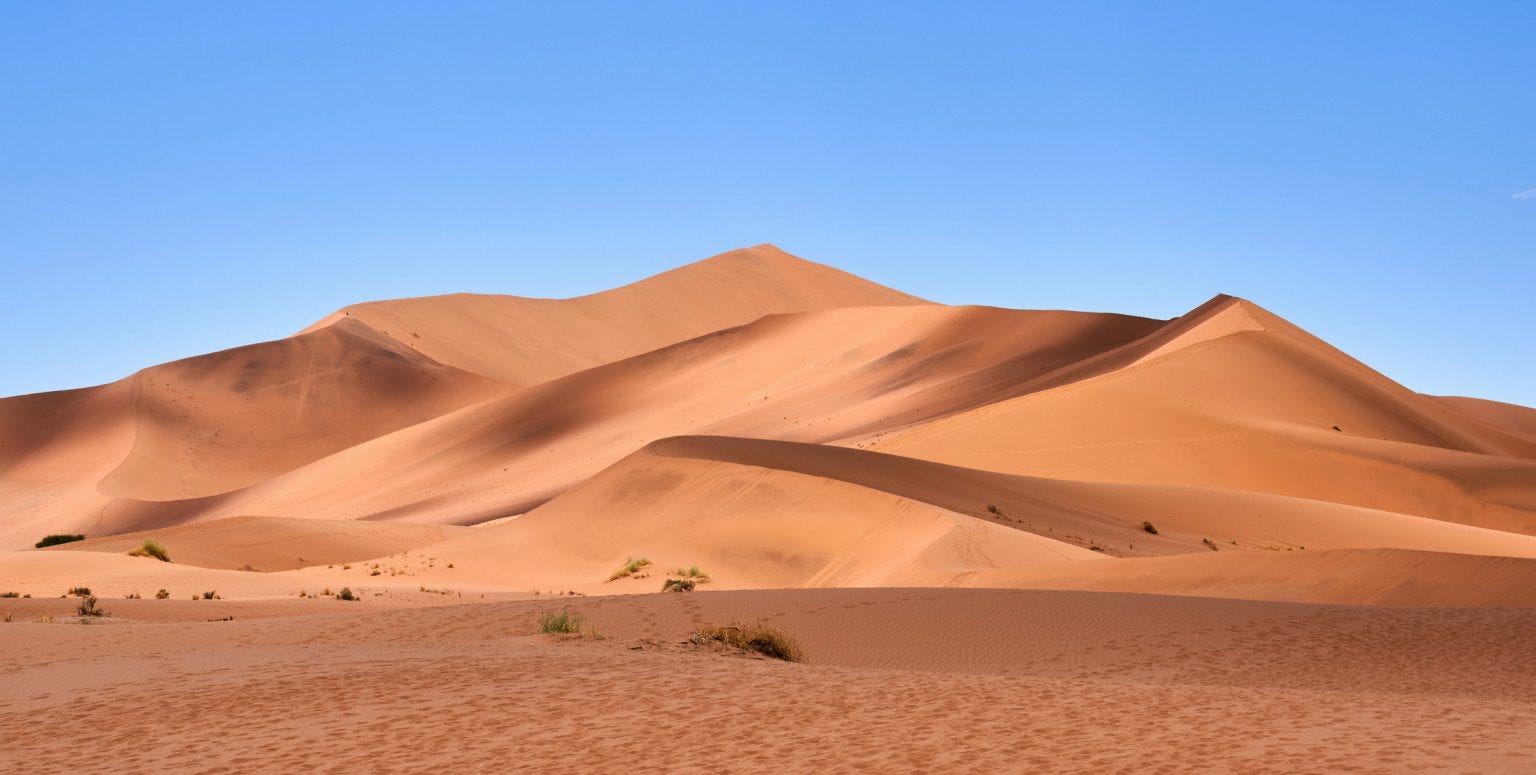
Coordinates are useless in liminal spaces like deserts. As in astral realms and other imaginal places, landmarks are subjective and therefore meaningless. It is more about feeling the place than finding it by way of directions or compasses, sort of like an emotional dead reckoning. So, I learned the location of the song's performance by way of my own yearning.
The locus of the song's performance was roughly a kilometer away from a towering dune that, due to the time of year, cast an unceasing shadow upon the ground where I stood. The sun's arch never cut directly over the dune, so only an hour of sunlight was available within the span of a day.
At first I thought this to be a wily trick perpetrated by the dune, whose sense of humor similar to that of the winds would not be so out of character, as all things in the deserts tend towards lying. But a full day's stay at the shadowy spot confirmed the scarcity of light hitting the grains of sand at my feet while the sun made its trajectory across the cloudless sky.
If the song had been sung roughly at this time of year, as I was given to believe, then the heat and the sun as a phenomenon known to inspire awe played little importance in the song's theme. I surmised that darkness, coldness, and an unrequited love that usually typifies those sentiments were probable themes of the desert song.
As anyone may know, deserts deal in extremes. Climates oscillate between an unbearable cold that matches the vigor of the insufferable heat. I shivered there during my stay, not foreseeing the need for extra garments save for the shawl and burnoose I had stripped from the dead camel driver. Crouching under the tall-legged camel helped quell the bite from the night winds somewhat.
After what seemed like an entire day's cycle, the winds that bombarded me from all quarters began to gradually abate then funnel into a swirling motion around my head. And I began to hear a song. Not knowing whether this was an aural phenomenon put on by the dune and other undetected peculiarities of the terrain, I swallowed my fear and listened.
It was the song. It was the song, the most beautiful song ever sung by the most beautiful woman ever, expressing the most beautiful emotion ever torn from a jilted lover's heart.
It was horrible to hear. There comes a point in a deep love's lifespan that it transforms into a wholesale despair. Jewels of once-captivating beauty tarnish into baubles of bleak hope and opaque blackness from which not a glimmer of light reflects. Yearning unfulfilled slips into broken dreams. The face of God, longed to be gazed upon by the curious of heart, transmogrifies into the nightmarish countenance of the devil, never to be forgotten.
I had my recording equipment going at all times. The green light indicator of my hard drive pulsated per usual. The contact mics, four total, were functional, evidenced by the occasional feedback given by the chafing winds. The best post-production studio work could not replicate the magic of a pop filter, which serves to eliminate the plosives that distort the sound. Since the vehemence of the desert winds had been tempered to fashion the song, the sine waves, if seen in an oscilloscope, would have the rounded contours of gentle sounds. Much of the chafing should therefore be not so much attributed to substandard recording equipment but to a biting sarcasm inherent in the song's lyrics.
I will save you a lifelong grief by denying you the lyrics in their entirety. Never should such abominable, forlorn love be expressed, let alone shared or spread forth like a melodious plague.
Only slightly less tasteless were the means by which I was able to coax the winds into translating the song into the tongue in which it had been sung. Winds are flawless recorders and even less flawless replicators, though they demand a price steep in sacrifice and steeped in blood.
Here is what I did so that the winds could sing me the desert song:
First, I [wind redaction]—